Quick Answer
A wire harness is usually a grouped set of wires and branches arranged to connect several points in a system, while a cable assembly is usually one cable or conductor set terminated with defined connectors or end features. The terms can overlap in supplier conversations, so an OEM RFQ should define the actual construction, interfaces, dimensions, electrical requirements, protection, testing, and documentation instead of relying on the product name alone.
What Is the Difference?
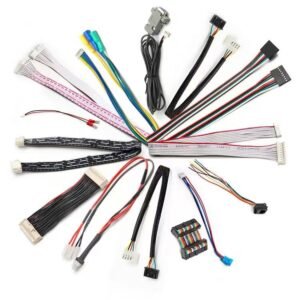
The distinction is practical rather than universal. A wire harness often includes multiple circuits, branches, clips, labels, looms, sleeving, terminals, and routing features. It is commonly installed inside equipment, control cabinets, vehicles, appliances, or industrial machinery.
A cable assembly often refers to a finished cable with one or more connectors, backshells, strain reliefs, overmolding, shielding, or protective covering. It may be a simple point-to-point interconnect, a sensor cable, a power lead, or a specialized interface cable.
Some suppliers use the terms differently. The controlled drawing and bill of materials should therefore take priority over the label used in a quotation.
When Should an OEM Specify a Wire Harness?
Use a wire-harness specification when the assembly has several circuits or a defined physical route through a product. Typical signals include:
- Multiple branches or connector destinations
- Clips, retainers, grommets, labels, or routing fixtures
- A fixed installation path inside a machine, vehicle, cabinet, or device
- Several wire sizes, terminal types, or circuit functions
- A need to control branch lengths and breakout locations
For these assemblies, the RFQ should show the complete topology, not only the total wire length.
When Should an OEM Specify a Cable Assembly?
A cable-assembly specification is often appropriate for a point-to-point interconnect or a cable with defined end terminations. Common examples include:
- Sensor and control cables
- Power leads and battery connection cables
- M12, D-sub, USB, coaxial, or other interface cables
- Shielded cables for instrumentation or industrial equipment
- Replacement cables made from an approved sample or drawing
The important questions remain the same: what mates, what carries the circuit, where is it installed, and how will acceptance be verified?
The RFQ Fields That Matter Most
1. Define the Interfaces
List the connector housing, terminal, seal, backshell, mating part, and keying requirements for every end. If a part number is unknown, provide close-up images, cavity count, dimensions, latch details, and a physical sample when permitted.
Do not identify an interface only by color, position count, or a visual resemblance to a familiar connector family.
2. Define Circuit Topology and Pinout
For a wire harness, provide a wiring diagram, pin-to-pin netlist, branch map, and cavity assignments. For a cable assembly, show the conductor-to-conductor mapping at each end.
Wire color is useful for assembly control, but it does not replace an approved pinout. The drawing revision should define the actual assignment.
3. Define Conductor and Insulation Requirements
Specify AWG or metric conductor size, stranding, insulation material, color, temperature rating, shielding, drain wires, and any flex-life requirement. If the application has voltage, current, bend, vibration, or chemical exposure limits, state them as engineering inputs.
4. Define Geometry and Installation Constraints
Include finished lengths, tolerances, branch lengths, breakout locations, bend radius, connector orientation, clocking, labels, clips, grommets, sleeving, braid, tape, conduit, or overmolding. State how each critical dimension is measured.
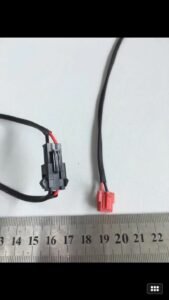
A ruler in a photo can provide context, but it does not replace a controlled dimension and tolerance.
5. Define Quality and Test Records
State the required tests and acceptance criteria. Depending on the application, this can include continuity, pin mapping, short-circuit detection, dimensional inspection, pull-force checks, insulation resistance, dielectric withstand, shielding continuity, sealing, or functional testing.
Also specify the required inspection record, sample quantity, drawing revision, traceability fields, and first-article approval process. Do not assume a supplier's standard test package is automatically suitable for the product.
Procurement Comparison: What to Ask Suppliers
Ask each supplier to identify assumptions in the quotation. A useful comparison includes:
| RFQ area | Buyer should confirm |
| Construction | Harness, cable assembly, or both; branch and routing requirements |
| Interfaces | Part numbers, mating parts, terminals, seals, keying |
| Electrical | Circuits, pinout, conductor size, voltage, current, shielding |
| Mechanical | Length, tolerance, orientation, bend radius, retention features |
| Environment | Temperature, vibration, moisture, oil, chemicals, UV, flexing |
| Quality | Tests, acceptance criteria, inspection records, traceability |
| Change control | Drawing revision, sample approval, deviation process |
The supplier should quote against the same controlled inputs. Otherwise, a lower price may simply reflect missing scope.
Common Specification Mistakes
Treating a Product Name as a Complete Specification
“Custom wire harness” or “cable assembly” is a category, not a build definition. The physical construction and acceptance criteria must be documented.
Sending Only One Photo
One photo may hide the mating interface, terminal, cavity orientation, branch geometry, or strain-relief detail. Provide multiple views, dimensions, and the known electrical function.
Omitting Revision and Change Control
Without a revision identifier, the buyer and supplier may quote or build different versions. Include revision, effective date, and approval responsibility.
Assuming Certification from Appearance
A component's appearance does not prove a certification, rating, or standard-compliance outcome. Confirm the applicable requirement and evidence for the specific project.
How WireAssyTech Can Support the RFQ Process
WireAssyTech can review a reference photo, sample, drawing, BOM, or existing cable and help identify the information needed for a more controlled quotation. Final material selection, validation scope, compliance status, lead time, and production commitments should be confirmed for the specific project before release.
Frequently Asked Questions
Is a cable assembly the same as a wire harness?
Not always. A cable assembly is often a point-to-point terminated cable, while a wire harness often contains multiple circuits, branches, and routing hardware. Supplier terminology varies, so the drawing and BOM control the requirement.
Can an OEM request a quote from a photo?
Yes, a photo can support an initial review or budgetary estimate. A production quotation should be based on verified interfaces, pinout, materials, dimensions, quantity, tests, and delivery requirements.
What is the first document to send a supplier?
Send the latest drawing and BOM when available. If those do not exist, send clear images of every interface, a physical sample if allowed, measured dimensions, known electrical details, and the intended application.
Should wire color define polarity?
No. Wire color can support visual identification, but the approved drawing or netlist must define polarity and cavity assignment.
What standard should be used for workmanship?
Use the customer, market, or project requirement that actually applies, and identify its exact revision. Do not imply IPC/WHMA-A-620, UL, or another compliance outcome unless it is verified for the specific product and facility.
Suggested References
Before publishing hyperlinks, verify the live WireAssyTech service URLs and use natural anchors such as custom wire harness manufacturing, cable assembly services, and request a quote. For external technical context, verify applicable connector datasheets, UL Solutions information, and the relevant IPC/WHMA-A-620 revision before linking or making a compliance claim.